Wednesday, March 23, 2022

Day 3 - Managing the Arthropods

Materials I use to tend to the
exhibits on display.
    Since Kaeli wasn't here, I worked with Celeste today. This morning I cared for the insects in the Brown Hall of Entomology by myself, which I was pretty proud of. I didn't mess with the Giant Malaysian Katydids, since they terrify me. Here's a video of the noise that they make: https://www.youtube.com/watch?v=f3HMYkL8qJU. I also had a hard time with the Harvestmen (basically daddy-long-legs). They are a self-sustaining colony, so there are many of them and they are very fast. They also like to hang upside down, which just so happens to be the way that you open the enclosure. I tried to wipe the condensation away, but they kept racing to get out, so I had to just leave it be. 

    Next, Celeste showed me to the containment room for the arthropods, which Kaeli had gone over the other day. We changed the leaves in the cages for the phasmids (leaf bugs, stick bugs, etc.), and I got to hold a few! We also checked the enclosure that had stick bug eggs, and since there was a baby stick bug that had hatched, we placed it into the other container with the other stick bug babies. The babies have a similar look to ants since the eggs contain some sort of protein that regular ants collect. Once an ant collects an egg, the egg can safely hatch in an ant colony (and appear as a regular ant). There was a meeting right after we did this, which was interesting to sit in on. It seemed like there were a lot of repairs that had to be done!

    After this, Celeste let me work on the rest of the cages on my own, so I first went through the cages that had a green sticker. These included grubs and cockroaches for the most part. There were about a dozen cages that I either had to mist and/or replace food. After this, Celeste taught me how to work with the more venomous arthropods, which were mainly tarantulas, scorpions, and centipedes. All I did was fill up their water bowls or give them a good mist since the carnivorous insects are fed on Fridays. The USDA requires any organic materials (dead bugs or old food) to be frozen before disposal, so I cleaned up and went on with my day.

Facts I learned: 

  • Katydids make their horrendous alarm sound by rubbing their wings together. 
  • Stick and leaf bugs are absolutely adorable and will stretch out their hands and wave around to find their way around.
Additional Research: 
  • Tarantulas
    • My favourite tarantulas on display are the Chilean Rosehair Tarantula and the Goliath Birdeater Tarantula. I just think they're both super cute and very beautiful, and after tending to their cages I really wanted to get my own! Tarantulas are fairly easy to care for, but I wanted to research more into the proper way to care for them. They can actually live up to 15-25 years, too! Price can vary depending on the species, and it is best to purchase from a breeder to get an idea of health history. Definitely avoid spiders that look hunched, and ask for the age and gender of the spider. Sometimes it is even a good idea to ask to see it eat. Generally speaking, different tarantulas will have different living situations. If they reside in a hole, then it is necessary to accommodate them! It is recommended that ground dweller tarantulas are best for beginners since they are generally slow-moving. It is also necessary to make sure that the temperature within their enclosures is right, and it should be about 75-80 degrees Fahrenheit and misted daily. Tarantulas are venomous, so if they feel threatened they will bite (so they are best not to handle). The Chilean Rosehair is actually a common one to keep as a pet, especially since its size is relatively small. A tarantula will need an enclosure that mimics its habitat. The enclosure needs to be of a decent size with ventilation- size will vary depending on if the tarantula is tree-dwelling or ground-dwelling. They also need a place to hide. They should be kept out of direct sunlight, and fed at night. They also need live prey, such as crickets (which are very easy to keep), roaches, and worms. Feeding the crickets well and dusting them with vitamin powder can also help the health of your tarantula. Juvenile tarantulas will eat every day or two, while adults only eat once a week. The quantity and variety depend, but at the HMNS each adult tarantula was given 3 crickets. It is also important to note that when a tarantula is moulting, it will not eat. Providing live prey could also injure the spider, as the exoskeleton needs to harden after moulting. This is common with most animals. A water dish should also be provided, but shallow to prevent drowning.  Refreshing the enclosure (cleaning it with reptile habitat cleaner and rinse) is recommended every 4-6 months. The substrate should be vermiculite (can be mixed with peat and/or potting soil) and 2-4 inches deep. When cleaning a tarantula's cage, it is best to coax them out, rather than using your hands. 

Tuesday, March 22, 2022

Day 2 - Learning How to Make Banana Brew and More!

    Today I was able to meet Celeste Castro, who runs the insect exhibits in the Brown Hall of Entomology. She showed me the same steps that Kaeli taught me yesterday, so I wiped down some enclosures, misted others, and sometimes replaced the food depending on its quality. Changing out the food is mainly for visual aesthetics- the insects love when it gets all gross and soggy, but the visitors don't! This time I also got to feed a carnivorous spider a dead butterfly, which was super cool to watch.

    Kaeli got me to restock the nectar (there are two types- one that is for general growth (looks like iced tea) and one that aids reproduction (a mix of nectar powder and warm water that forms a pale yellow)) in the Conservatory. Then we went back to a kitchen where a volunteer named Martha, who had been volunteering for almost two whole decades, was feeding the retired iguana Charlie. I also learned that the iguana that's cruising around the Conservatory is named 'Nacho'. In the kitchen, Kaeli showed me how to prepare banana brew, which requires 8 overly ripe bananas, 1/4 cup of brown sugar, and, get this: A third of a cup of Guinness beer! This helps aid fermentation in the brew. 

    I worked with Joanne, another volunteer who had been working there for about 3 years, to release the butterflies. Same process as before! This time I got to use the net to catch a few that had gotten loose in the room. After releasing the butterflies, Kaeli showed me back to the kitchen where we sorted through the deceased butterflies in the freezer from the Conservatory. Basically, we were just tossing the butterflies that were super tattered or ripped and placing the ones that were still intact into Ziploc bags. These butterflies usually were sent to people that wanted to use them in art or for display.

    Kaeli then showed me the greenhouses that were on the roof of the museum, which was where they 'reared' (bred) the butterflies using host plants. I was able to meet the person who managed the greenhouses and also was in charge of what butterflies the museum received. He showed me a birdwing caterpillar, which was super cute! Kaeli also showed me where they had chrysalides for Anna's 88 butterflies, which are some of my favourites. I also love the Malachite and Blue Morpho butterflies. Then Kaeli and I headed back to where the butterflies are hatched to handle the chrysalides that had fallen down (which are stored in little cages outside the chambers). After organising the chrysalides based on species, Kaeli took out one of the shelves (made of styrofoam) from the chambers and got a glue gun, pins, and string to start hanging the chrysalides back up. She tied both ends of a length of string and pinned both ends down on the styrofoam shelf. She hot-glued a laminated label of one of the butterfly species to the string. Then, going down the length of the string, we glued down the chrysalides at their abdomen (so they would hatch upside down and their wings could dry). After that, Kaeli showed me the cage where they kept the Atlas moths, which were yet to hatch. 

    Today was great! I was really happy that I got to try out new tasks. Tomorrow I might be able to learn more about how to care for the reptiles in the Conservatory, which I'm super excited about! Especially since Kaeli told me that I'd get a chance to polish the turtles' shells. 

Facts I learned: 

  • Some butterflies have tattered wings, but that's just because they're older
  • Butterflies have a really weird fruity smell that is similar to the smell of Durian
Additional Research: 
  • Malachite Butterflies
    • These butterflies are native to "Brazil north to Central America, Mexico, and the West Indies to Southern Florida and South Texas" (Butterflies & Moths, 2022). Malachite butterflies farther north are emigrating from Cuba. They are commonly found in mango, citrus, and avocado orchards in Florida and in subtropical forests. They drink nectar and eat rotting fruit. Butterflies usually appreciate rotting fruit more, but due to visitors, the HMNS changes out the fruit often.
    • The website that this information comes from is really interesting since you can actually record when you have seen a butterfly in a certain area.
  • Blue Morpho Butterflies 
    • These butterflies are very famous for their inner wings, but I was originally fascinated by the pattern on their outer wings which has multiple circles that are ringed with orange and blue and brown- just beautiful! The blue scales on their inner wings aren't actually blue, either- it's simply how light is reflected off of them. The scales are actually white when in the dark. These butterflies originate "in the tropical forests of Latin America from Mexico to Colombia", (Rainforest Alliance, 2012). The lifespan of a Blue Morpho usually lasts only 115 days. The diet of these butterflies also consists of the liquids from rotting fruit, dead animal matter, tree sap, fungi, and wet mud (puddling). These butterflies can taste fruit with sensors on their legs, and use their antennae as both a tongue and a nose. These butterflies are severly endangered due to deforestation. 
  • Anna's 88 Butterflies
    • It is still a marvel to me on why certain species of butterflies develop patterns in the way that they do! This butterfly has an 88 on each of its outer wings. They are very small in size, and their habitats are generally tropical forests. Evidentally, they are found in Costa Rica, Mexico, and sometimes South Texas. Their main food sources is dung and rotten fruit. 
    • There has been some research on butterflies claiming that lack of food is resulting in lower numbers to appear during migration.

Monday, March 21, 2022

Day 1 - First Day at the HMNS

    Today was the first day of interning at the Houston Museum of Natural Science-- specifically in the 'entomology' section which focuses on the study of insects. Kaeli Nichols, a butterfly biologist that had been working there for a year, showed me everything that I'd be doing during my A-Term.

    The first thing that we did was tend to the needs of the insects in the Brown Hall of Entomology. Kaeli showed me the steps that she usually goes through when maintaining the habitats that the insects stay in: (1) Check if the enclosure is fogged up. If it is, you don't need to use the spray bottle to increase the humidity and simply need to wipe down the glass. If the enclosure has sand at the bottom, you only need to give the back wall a decent spray. (2) Change out the food in the enclosure if it looks gross. Simple as that. (3) If there are any dead insects that were meant to feed the insect featured in the exhibit, remove them. If you haven't seen the featured insect, it might be dead. "It isn't rocket science," as Kaeli said! 

    The next thing that Kaeli demonstrated was how to replace the food sources for the butterflies in the Cockrell Butterfly Garden, AKA the 'Conservatory'. First, we removed the torches, hangers, and pots that held the nectar for the butterflies. The pots held banana brew, which was a mix of brown sugar and really ripe bananas. Since it had been sitting there in the humidity for about a week, it looked absolutely delicious! We brought all the materials to a sink in a back room where Charles the Iguana was bathing in the bliss of his so-called "retirement". Then we took out new torches and hangers (along with sponges to put in the torches/hangers), placed them back out in the conservatory and topped them up with nectar. The pots were also restocked with the delectable banana brew. Soon after, we removed the suet baskets and plates that held fruit and replaced them with freshly chopped oranges, kiwi, pineapples, watermelon, and more. After that, we cleaned up and prepared for the next task. I think the most challenging thing about this part of the project was the fact that I had to remember where all the hangers, plates, and torches were located throughout the garden. I'll have plenty of time to get lost in the next two weeks, so no worries! 

    This next task was definitely my favourite. Kaeli showed me a door located behind the chrysalis display, which basically was where you could open up the chambers and collect the hatched butterflies for the first release of the day (generally, there are two releases). For each chamber, after opening the doors, most of them tended to fly around, which was totally fine. Kaeli showed me how to catch em' with a net! She also showed me the proper way to handle the butterflies. When they're at rest and their wings are closed, all you need to do is take your pointer finger and your middle finger and clamp them around the wings. This doesn't harm the butterfly at all! You can also gently make a claw with your hand if they're beating their wings. Once you have one, all you need to do is put them into a butterfly 'cage', which is the same material as a butterfly net. Some butterflies will have floppy, damp wings if they have just hatched, and all you need to do is let them chill there until their wings dry and stiffen. Unfortunately, some butterflies won't always make it. Those who have curled wings or haven't hatched fast enough, they are euthanised. It isn't a very dignifying way to go, as you simply place them in the freezer along with other dead relatives that didn't make it, but it is certainly a way to go. After this, I took a sponge and some bleach to wipe down the chamber. This is because meconium is released when a butterfly hatches, and it. Gets. Everywhere. It also just so happens to resemble blood, which is pleasant. There are paper towels that rest above where the chrysalides are hanging, which just helps keep the humidity (which I can check on a gadget next to the chambers) high. Since these towels get gross fast, I tossed the old ones and place two layers of four paper towels on top of each other and douse them in water. The bottom of the enclosure has a sort of carpet that sometimes gets gross, so all I do is change it out with a new carpet. To increase the humidity more, Kaeli told me to just dump water at the bottom of the enclosure. The final thing is wiping down the window of the display. After that, I took the collected butterflies to the conservatory and released them, which was gorgeous to watch!

    The final thing that Kaeli showed me how to do is care for the insects that aren't on display. Each container is marked with a green, a yellow, or a red sticker that shows you how dangerous each insect is. Luckily, I only dealt with the chambers that had a green sticker. She slowly went around the room and showed me the same steps that applied to the insects on display. This time, though, there were containers with eggs. All you had to do with these containers was take out any babies that had hatched, place them in a container with other babies of the same species, and give the eggs a good spray. I was also able to tend to the containers that had grubs and cockroaches on my own. All you did was replicate the remnants of the food in them and spray them down. I will say, I am very proud of myself for not only removing the food but replacing the food from a giant enclosure containing about 100 hissing cockroaches. They did not hiss, that is just their glamourous name! 

    Overall I'd say that today was one of the most fascinating learning experiences I've ever had. I absolutely cannot wait to learn more, especially when caring for the reptiles that are in the conservatory. According to Kaeli, that task is yet to come! 

Facts I learned: 

  • What you feed an insect can affect if it breeds or not
  • Owl butterflies in the conservatory sometimes confuse certain plant species with their host plant, which causes them to lay eggs. That is not what the HMNS wants to happen, or else there would be hundreds of butterflies in the enclosure. It would also not help the eggs, since the caterpillars wouldn't be able to eat the plant anyway.
  • When a butterfly gets loose, the USDA has to be alerted for agricultural reasons. 
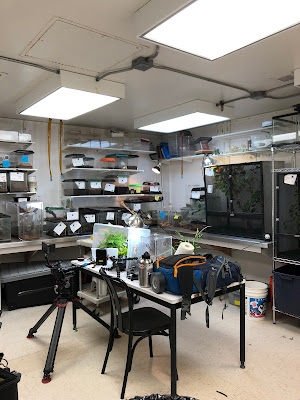
This is the containment room for the arthropods
that are not on display. I worked with the enclosures 
in the centre and to the right. 


Additional Research:
  • What is the role of insects in our ecosystem?
    • Insects play an enormous role in our ecosystem. According to National Geographic, "there are about 1.4 billion insects for every human on earth". Insects are an essential part of the food chain, and therefore they are indirectly supporting entire industries. They are eaten by birds, mammals, and fish. They also help in decomposition, which not only releases nutrients that helps plants to grow but also prevents the build up of dead matter or excretion. They help in the pollination of "80% of trees and bushes on the entire planet" (Sawe, 2019), and it is clear why these plants are needed to sustain the earth. Insects also help with seed dispersal by consuming fruit. In addition, some plants only allow pollination by a specific species of insect. And obviously, bees are basically the most important pollinators in the ecosystem, and also contribute to the food industry. Insects are also very nutritional for humans. It is also a part of the culture in many ethnic groups to eat insects- on the Island of Sardinia, people eat 'crying cheese', which is made with maggots. Replacing insects with agricultural livestock can also help in reducing greenhouse gas emissions and help to save grain. Insects also help in biological control- predaceous insects help control diseases or crops. For example, young ladybugs will eat aphids, and aphids eat plants. They can also provide cultural services in terms of tourism. Finally, insects help create medicines that can improve ailments such as tendonitis, and provide products such as silk, dyes, and shellac. 
  • How does diet affect mating?
    • A study by the University of Edinburgh (2019) found that diet affected the mating habits of burying beetles, "which become sexually mature a few days after reaching adulthood" (Richardson, 2019). The scientists raised males and females separately before pairing them together for mating, and some were fed less than others either before and/or after this pairing. According to the research found, females that were fed less preferred to mate with males that were fed more. Researchers suggest that this was because they "seeked to optimise the health of their offspring by choosing a partner in relatively good condition," (Richardson, 2019). Males that were fed less "spent more time making courtship signals, possibly to avoid physically competing with other males for mates," (Richardson, 2019). Further research is attempting to investigate what impact this could have on offspring. 
    • As stated in the article, this could have an enormous impact on how we understand animal behaviour and how climate change's affect on food availability may disrupt the ecosystem.


Day 10 - Learning How to Pin Butterflies

    Today was, unfortunately, my final day interning at the HMNS. Hopefully, with the training I've gained from this experience, I will ...